أيها الصينيون الأحرار ...... لن ننساكم
مذبحة ميدان تيانينمن
5/6/2010

Residents came out to the street to wave and welcome troops that is loyal to the moderate leadership in Beijing, Tuesday, June 6, 1989. There is confirmed reports of fighting between moderate troops against the hardiners troops, the latter shot their way to Tiananmen square and resulted in the worst massacre in modern time. (AP Photo/LIU Heung Shing)
Read more: http://www.kansascity.com/2010/06/03/1989533/tiananmen-square-protests-of-june.html#ixzz0pymfpsvD
Read more: http://www.kansascity.com/2010/06/03/1989533/tiananmen-square-protests-of-june.html#ixzz0pymfpsvD

Chinese troops and tanks gather in Beijing, June 5, 1989, one day after the military crackdown that ended a seven week pro-democracy demonstration on Tiananmen Square. Hundreds were killed in the early morning hours of June 4. (AP Photo/Jeff Widener) Read more: http://www.kansascity.com/2010/06/03/1989533/tiananmen-square-protests-of-june.html#ixzz0pymLK4mw

Shanghai residents used empty buses to block possible troops at an intersection in the largest city of China, Monday, June 9, 1989, Shanghai, China. A wreath was placed on top of the bus to mourn the pro-democracy movements victims massacred in Beijing. (AP Photo) Read more: http://www.kansascity.com/2010/06/03/1989533/tiananmen-square-protests-of-june.html#ixzz0pym5y4cn

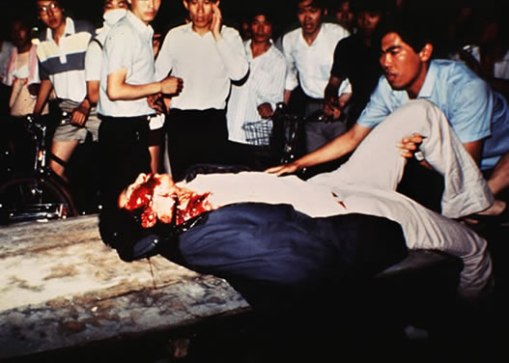
Beijing citizens yell oaths against the government as they gather around the body of a man who died when an armoured personnel carrier on its way to Tiananmen Square crashed through a troop convoy which had been stopped by people on Saturday, June 4, 1989 in Beijing, China. (AP Photo/Mark Avery) Read more: http://www.kansascity.com/2010/06/03/1989533/tiananmen-square-protests-of-june.html#ixzz0pylrwf4a

A young woman is caught between civilians and Chinese soldiers, who were trying to remove her from an assembly near the Great Hall of the People in Beijing, June 3, 1989. Pro-democracy protesters had been occupying Tiananmen Square for weeks. (AP Photo/Jeff Widener) Read more: http://www.kansascity.com/2010/06/03/1989533/tiananmen-square-protests-of-june.html#ixzz0pylikZtV

Civilians hold rocks as they stand on a government armored vehicle near Chang'an Boulevard in Beijing, early June 4, 1989. Violence escalated between pro-democracy protesters and Chinese troops, leaving hundreds dead overnight. (AP Photo/Jeff Widener) Read more: http://www.kansascity.com/2010/06/03/1989533/tiananmen-square-protests-of-june.html#ixzz0pylVlJMS

Chinese military items, including rifles, helmets, and a hat, are displayed during the pro-democracy demonstration that lasted from mid-April to early June 1989 on Beijing's Tiananmen Square. The demonstration ended with a government crackdown on June 4, 1989, leaving hundreds dead. (AP Photo/Jeff Widener) Read more: http://www.kansascity.com/2010/06/03/1989533/tiananmen-square-protests-of-june.html#ixzz0pylDdynU

A huge crowd gathers to watch as student protestors burn copies of Beijing Daily in retaliation for anti-student articles in front of the newspaper's offices, Friday, June 2, 1989, Beijing, China. (AP Photo/Jeff Widener) Read more: http://www.kansascity.com/2010/06/03/1989533/tiananmen-square-protests-of-june.html#ixzz0pykvTmxe

A crowd of Chinese opens hole to give a busload of foreign tourists a view of a dead body Monday morning, June 5, 1989, of victim of the first night of violence as People's Liberation Army troops shot their way into Tiananmen Square to crush pro-democracy protests. (AP Photo/Mark Avery) Read more: http://www.kansascity.com/2010/06/03/1989533/tiananmen-square-protests-of-june.html#ixzz0pykZq5pQ

A Chinese man stands alone to block a line of tanks heading east on Beijing's Cangan Blvd. in Tiananmen Square on June 5, 1989. The man, calling for an end to the recent violence and bloodshed against pro-democracy demonstrators, was pulled away by bystanders, and the tanks continued on their way. The Chinese government crushed a student-led demonstration for democratic reform and against government corruption, killing hundreds, or perhaps thousands of demonstrators in the strongest anti-government protest since the 1949 revolution. Ironically, the name Tiananmen means "Gate of Heavenly Peace". (AP Photo/Jeff Widener) Read more: http://www.kansascity.com/2010/06/03/1989533/tiananmen-square-protests-of-june.html#ixzz0pykG4oME

A youngster swings on the barrel of a disabled tank as others satisfy their curiosity in a Beijing Street, Friday, June 9, 1989. The tank was disabled when People's Liberation Army soldiers swept through Tiananmen Square last week. (AP Photo/Jeff Widener) Read more: http://www.kansascity.com/2010/06/03/1989533/tiananmen-square-protests-of-june.html#ixzz0pyk2Au3E

A man tries to pull a Chinese soldier away from his comrades as thousands of Beijing citizens turned out to block thousands of troops on their way towards Tiananmen Square in Beijing, China, June 3, 1989. (AP Photo/Mark Avery) Read more: http://www.kansascity.com/2010/06/03/1989533/tiananmen-square-protests-of-june.html#ixzz0pyjldowJ

The driver of an armoured personnel carrier that rammed through student lines, injuring many, lies dead after being beaten by students who set his vehicle on fire during an army attack on Tiananmen Square in Beijing, China, June 4, 1989. (AP Photo/Jeff Widener) Read more: http://www.kansascity.com/2010/06/03/1989533/tiananmen-square-protests-of-june.html#ixzz0pyjW07hQ