Showing posts with label China. Show all posts

Saturday, June 05, 2010


أيها الصينيون الأحرار ...... لن ننساكم
مذبحة ميدان تيانينمن
5/6/2010
Residents came out to the street to wave and welcome troops that is loyal to the moderate leadership in Beijing, Tuesday, June 6, 1989. There is confirmed reports of fighting between moderate troops against the hardiners troops, the latter shot their way to Tiananmen square and resulted in the worst massacre in modern time. (AP Photo/LIU Heung Shing)

Read more: http://www.kansascity.com/2010/06/03/1989533/tiananmen-square-protests-of-june.html#ixzz0pymfpsvD

Chinese troops and tanks gather in Beijing, June 5, 1989, one day after the military crackdown that ended a seven week pro-democracy demonstration on Tiananmen Square. Hundreds were killed in the early morning hours of June 4. (AP Photo/Jeff Widener) Read more: http://www.kansascity.com/2010/06/03/1989533/tiananmen-square-protests-of-june.html#ixzz0pymLK4mw

Shanghai residents used empty buses to block possible troops at an intersection in the largest city of China, Monday, June 9, 1989, Shanghai, China. A wreath was placed on top of the bus to mourn the pro-democracy movements victims massacred in Beijing. (AP Photo) Read more: http://www.kansascity.com/2010/06/03/1989533/tiananmen-square-protests-of-june.html#ixzz0pym5y4cn

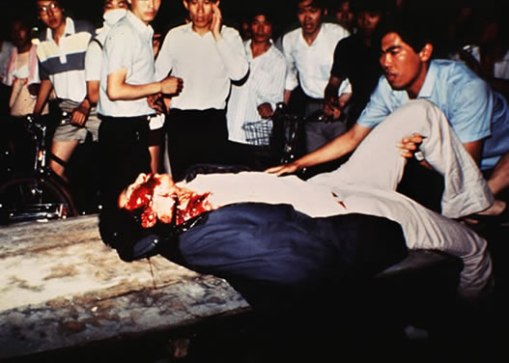
Beijing citizens yell oaths against the government as they gather around the body of a man who died when an armoured personnel carrier on its way to Tiananmen Square crashed through a troop convoy which had been stopped by people on Saturday, June 4, 1989 in Beijing, China. (AP Photo/Mark Avery) Read more: http://www.kansascity.com/2010/06/03/1989533/tiananmen-square-protests-of-june.html#ixzz0pylrwf4a

A young woman is caught between civilians and Chinese soldiers, who were trying to remove her from an assembly near the Great Hall of the People in Beijing, June 3, 1989. Pro-democracy protesters had been occupying Tiananmen Square for weeks. (AP Photo/Jeff Widener) Read more: http://www.kansascity.com/2010/06/03/1989533/tiananmen-square-protests-of-june.html#ixzz0pylikZtV

Civilians hold rocks as they stand on a government armored vehicle near Chang'an Boulevard in Beijing, early June 4, 1989. Violence escalated between pro-democracy protesters and Chinese troops, leaving hundreds dead overnight. (AP Photo/Jeff Widener) Read more: http://www.kansascity.com/2010/06/03/1989533/tiananmen-square-protests-of-june.html#ixzz0pylVlJMS

Chinese military items, including rifles, helmets, and a hat, are displayed during the pro-democracy demonstration that lasted from mid-April to early June 1989 on Beijing's Tiananmen Square. The demonstration ended with a government crackdown on June 4, 1989, leaving hundreds dead. (AP Photo/Jeff Widener) Read more: http://www.kansascity.com/2010/06/03/1989533/tiananmen-square-protests-of-june.html#ixzz0pylDdynU

A huge crowd gathers to watch as student protestors burn copies of Beijing Daily in retaliation for anti-student articles in front of the newspaper's offices, Friday, June 2, 1989, Beijing, China. (AP Photo/Jeff Widener) Read more: http://www.kansascity.com/2010/06/03/1989533/tiananmen-square-protests-of-june.html#ixzz0pykvTmxe

A crowd of Chinese opens hole to give a busload of foreign tourists a view of a dead body Monday morning, June 5, 1989, of victim of the first night of violence as People's Liberation Army troops shot their way into Tiananmen Square to crush pro-democracy protests. (AP Photo/Mark Avery) Read more: http://www.kansascity.com/2010/06/03/1989533/tiananmen-square-protests-of-june.html#ixzz0pykZq5pQ

A Chinese man stands alone to block a line of tanks heading east on Beijing's Cangan Blvd. in Tiananmen Square on June 5, 1989. The man, calling for an end to the recent violence and bloodshed against pro-democracy demonstrators, was pulled away by bystanders, and the tanks continued on their way. The Chinese government crushed a student-led demonstration for democratic reform and against government corruption, killing hundreds, or perhaps thousands of demonstrators in the strongest anti-government protest since the 1949 revolution. Ironically, the name Tiananmen means "Gate of Heavenly Peace". (AP Photo/Jeff Widener) Read more: http://www.kansascity.com/2010/06/03/1989533/tiananmen-square-protests-of-june.html#ixzz0pykG4oME

A youngster swings on the barrel of a disabled tank as others satisfy their curiosity in a Beijing Street, Friday, June 9, 1989. The tank was disabled when People's Liberation Army soldiers swept through Tiananmen Square last week. (AP Photo/Jeff Widener) Read more: http://www.kansascity.com/2010/06/03/1989533/tiananmen-square-protests-of-june.html#ixzz0pyk2Au3E

A man tries to pull a Chinese soldier away from his comrades as thousands of Beijing citizens turned out to block thousands of troops on their way towards Tiananmen Square in Beijing, China, June 3, 1989. (AP Photo/Mark Avery) Read more: http://www.kansascity.com/2010/06/03/1989533/tiananmen-square-protests-of-june.html#ixzz0pyjldowJ

The driver of an armoured personnel carrier that rammed through student lines, injuring many, lies dead after being beaten by students who set his vehicle on fire during an army attack on Tiananmen Square in Beijing, China, June 4, 1989. (AP Photo/Jeff Widener) Read more: http://www.kansascity.com/2010/06/03/1989533/tiananmen-square-protests-of-june.html#ixzz0pyjW07hQ


Friday, June 04, 2010


مذبحة ميدان تيانينمن
أبدا لن ننساكم

Tens of thousands of residents take part in a candlelight vigil in Hong Kong's Victoria Park on Friday, June 4, 2004, marking the 15th anniversary of the crackdown by the Chinese government on pro-democracy activists in Tiananmen Square in Beijing in 1989. Ever since Beijing sent tanks and troops to crush the Tiananmen Square pro-democracy movement, Hong Kong residents have led a candlelight vigil on the anniversary. Thousands of protesters demanded that China admit mistakes in its bloody crackdown onthe nonviolent student protesters that killed hundreds if not thousands. (AP Photo/Anat Givon)

Demonstrators hold candles and sing as they take part in a candlelight vigil in Hong Kong's Victoria Park on Tuesday June 4, 2002, to commemorate the 13th anniversary of the military crackdown on protests in Tiananmen Square in Beijing. Local media reported that 10,000 Hong Kong residents showed up to mourn the army assault which killed hundreds, perhaps thousands, of unarmed demonstrators on June 4, 1989. (AP Photo/Anat Givon)

A Chinese man wearing a T-shirt with protest slogans is tackled by a military policeman after he threw leaflets in Beijing's Tiananmen Square Friday, June 4, 1999, the 10th anniversary of the bloody military assault on pro-democracy demonstrators. The man, who claimed to be a Beijing University student, was protesting official corruption, a key complaint of the 1989 protesters. Hundreds died when troops shot their way through the city streets on June 4, 1989, to retake the square from student led demonstrators who had occupied it for seven weeks. (AP Photo/Greg Baker)
Demonstrators holding banners march through a Hong Kong downtown street Sunday, May 31, 1998, to honor those who were killed in the bloody crackdown on the pro-democracy movement in China nine years ago. The banner in front on which is painted a demonstrator facing Chinese tanks called on people ``not to forget'' the massacre. (AP Photo/Vincent Yu)

TIANENMEN
We will never forget


China begins internet 'blackout' ahead of Tiananmen anniversary

China has begun imposing an information blackout ahead of the 20th anniversary of the Tiananmen Square massacre, blocking access to popular networking websites such as Twitter and BBC television reports inside China.

The measures came as the authorities tried to close all avenues of dissent ahead of Thursday's anniversary, placing prominent critics under house arrest and banning newspaper from making any mention of the pro-democracy protests.

The co-ordinated internet "takedown" occurred at 5pm local time (10am GMT) on Tuesday as a broad range of websites suddenly became unavailable to Chinese internet users. Among the blocked sites was the blogging portal MSNSpaces, the Hotmail email service, Yahoo's photo-sharing site Flickr.com and Microsoft's new search engine Bing.com.

However, in a sign of how it is becoming increasingly difficult for the Chinese to control the internet, Twitter users found alternative outlets in rival providers to evade the censors.

Foreign newspaper and television channels were also subject to censorship as the highly sensitive anniversary approached.

Viewers of the BBC's world channels in Beijing found their screens turning black whenever reports on the anniversary were being aired and four foreign television crews attempting to film in Tiananmen Square reported being stopped by police.

Print publications were also affected, with many subscribers to The Economist magazine receiving their weekly copies with the Tiananmen-related pages ripped out. Readers of the Financial Times and South China Morning post also reported missing pages.

Over the last 20 years China's ruling Communist Party has refused to apologise for the deaths of hundreds, and possibly thousands, of protesters who were shot or crushed by tanks on the night of June 3-4, 1989.

Ignoring calls at home and abroad to pardon jailed demonstrators and "reassess" the events at Tiananmen, party officials have unwaveringly maintained the line that the protests were "counter-revolutionary riots" that were suppressed for the good of the country.

Qin Gang, foreign ministry spokesman, said yesterday: "The party and the government long ago reached a conclusion about the political incident that took place at the end of the 1980s and related issues."

The tightening of censorship ahead of Thursday's anniversary drew criticism from civil rights groups, including the press freedom watchdog Reporters Without Borders which issued a report condemning the lack of progress on media freedoms in China.

Renee Xia, of the banned Chinese Human Rights Defenders group, said the party continued to invest huge resources in keeping the Tiananmen massacre out of the public consciousness.

"Why? Because the Chinese leaders know they have blood on their hands. They fear that if the truth comes to light, the government will be under pressure to bring those responsible for this crime to justice," she said.

The Foreign Correspondents Club of China said it "deplored" the attempts to block reporting of the Tiananmen anniversary which it claimed went against the spirit of the relaxed reporting regulations that were introduced in the run-up to last year's Olympic Games in Beijing.

It accused the authorities of preventing at least four television crews from entering Tiananmen Square, harassing a reporter who interviewed the mothers of the victims and interrogating students who had given interviews.

As well media restrictions, the authorities have also silenced several leading dissidents, including Bao Tong, former secretary to Zhao Ziyang, the Communist Party leader purged for sympathising with the protesters. He was ordered to leave Beijing by security agents.

In another incident former Tiananmen Square protester who wrote an open letter to China's leaders complaining that political prisoners were still being refused jobs, pension and medical benefits 20 years after the massacre was also arrested, a human rights group reported.

Wu Gaoxing, a former teacher in his late 60s who was jailed for two years for his role in the protests was picked up in the eastern city of eastern city of Taizhou on Saturday, according to the New York-based group Human Rights in China.

Commemorations to mark the anniversary are being planned around the world, including Hong Kong where a small group of students have they will stage a 64-hour hunger-strike in commemoration the hunger-striking students of 1989.

In London Amnesty International UK said it was asking members to hold candlelit vigils while three former survivors of the repression laid flowers of commemoration outside the Chinese Embassy.

By Peter Foster in Beijing
Published: 1:40PM BST 02 Jun 2009

The Telegraph

Tiananmen Square memoir claims China decided to 'spill some blood'

China decided that it had no choice but to "spill some blood" during the Tiananmen Square massacre in order to preserve stability, a new memoir by a top leader of the time has claimed.

The phrase, attributed to China's then paramount leader Deng Xiaoping, appears in a previously suppressed diary which publishers say will lift the veil of secrecy over how the decision was made to send in the tanks on the night of June 3-4.

Leaked extracts of the diary said to be by Li Peng, the hardline former head of China's government in 1989 who is most deeply associated with the bloody crackdown, appeared yesterday as dissidents commemorated the 21st anniversary of the Tiananmen Square.

The measures for martial law must be steady-handed, and we must minimise harm, but we must prepare to spill some blood," Deng told officials on May 19 1989, according to a copy of the manuscript.

Mr Li, now 81 and reportedly in frail health, is said to have written his diary to justify his own role in the killings and to counter long-standing beliefs in China that it he pressured Deng Xiaoping into ordering the use of lethal force.

"From the beginning of the turmoil, I have prepared for the worst," Mr Li is quoted as saying.

"I would rather sacrifice my own life and that of my family to prevent China from going through a tragedy like the Cultural Revolution," he added, referring to a period of bitter political in-fighting in China from 1966-76.

The memoirs come a year after the publication of the secret memoirs of Zhao Ziyang, the Communist Party general secretary, who Premier Li helped push from office for seeking to negotiate with the protestors.

The publishers say they taken every possible to assess the authenticity of the memoirs which were passed to them through a middle-man, but admit that some doubts remain which will set out in a footnote to the book that will come out later this month.

News of the Li Peng memoir came as an estimated 50,000 people, many of them students, gathered in Hong Kong's Victoria Park for the annual candlelit vigil to commemorate the anniversary of the massacre.

All mention of the "Tiananmen Incident" is suppressed in mainland China, with the authorities banning any mention in the state-controlled media, although former dissidents expressed their feeling through online forums.

It was quiet in central Beijing on Friday as black cars marked "special police" - each manned with two armed officers wearing helmets and flak jackets - patrolled at regular intervals.

However, in a message to mark the anniversary, Taiwan's president Ma Ying-jeou said that China must learn the lessons from 1989 and be more tolerant toward dissidents if it wants to convince the rest of the world of its good intentions.

Mr Ma urged Beijing to adopt "a brand new approach to human rights issues and [to] convince the world that the rise of mainland China was peaceful and would embody the universal values of freedom, democracy and human rights." Elsewhere another of the leading figures of the 1989 movement, the student activist Wu'er Kaixi who was listed as number two on the government's "most wanted" list, was arrested trying enter the Chinese embassy in Tokyo.

Now 42, Wu'er Kaixi, became a celebrity overnight after he dared to interrupt Li Peng during a meeting between student leaders and politicians that was aired live on state television on May 18, 1989.

Last year, on the 20th anniversary of the massacre Wu'er Kaixi tried to enter Macau to hand himself over to the authorities, but was refused entry and deported back to Taiwan where he has been living in exile.

After returning to Taipei he said at the time: "I am deeply saddened that I have not been able to see my family for 20 years and that my intention to return by turning myself in was barred.

"The Chinese government is avoiding something that happened 20 years ago...

I am wanted in China but I cannot even turn myself in. Is China really a confident, great nation?"

By Peter Foster in Beijing
Published: 9:00PM BST 04 Jun 2010

Telegraph